

Product design in rail freight transport
Every transport problem has very specific requirements, be it procedural requirements of the producer, shipper and/or recipient, infrastructural conditions, characteristics of the cargo, handling and storage requirements, railway operating and commercial conditions, and much more. Understanding these requirements and the scope for manoeuvre available for all factors is a necessary condition for developing a rail freight transport product that optimally fits the products process requirements, addresses the customer needs and is econically attractive, with all the necessary ancillary services. An operator-neutral perspective supports this process.
Example of a rail-based circular economy without rail sidings
Task:
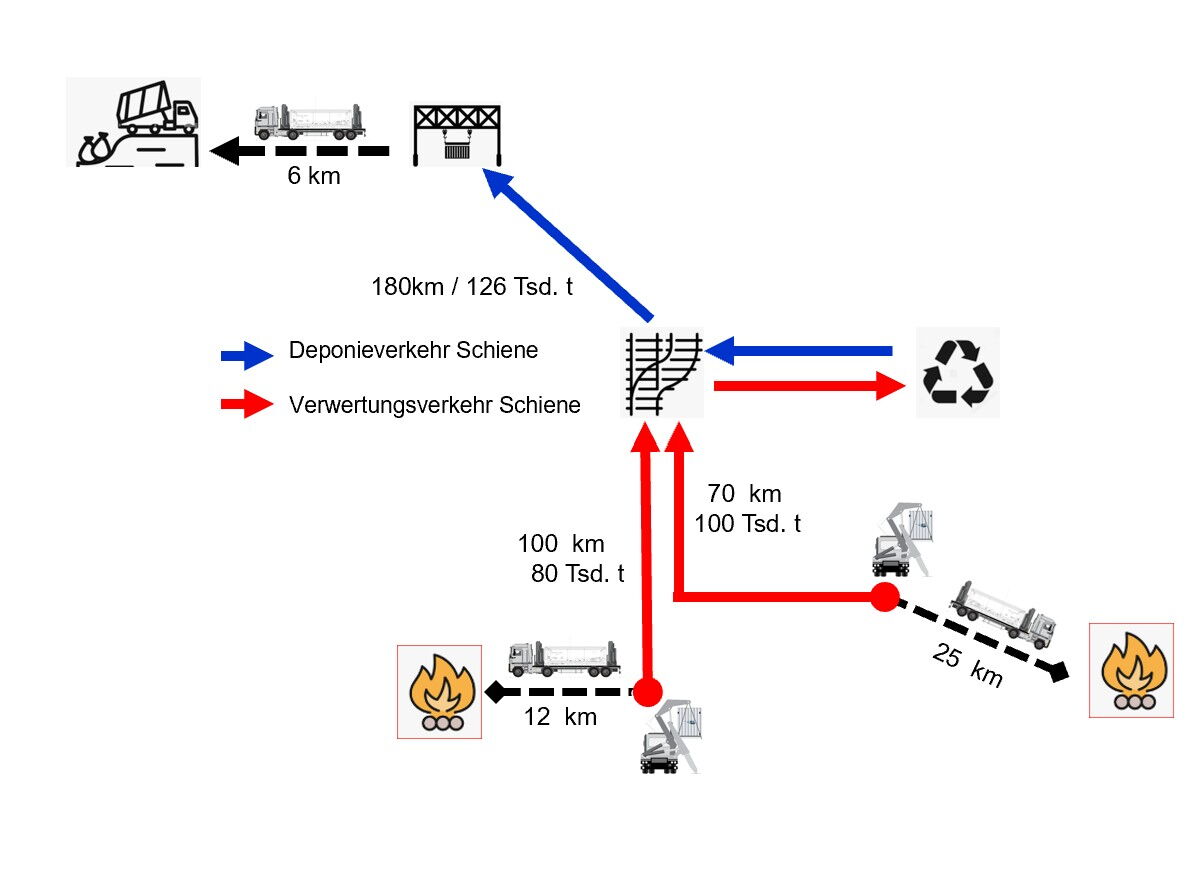
Disposal of boiler ash and slag from two waste incineration plants without a rail siding, annual volume 80,000 resp. 100,000 tonnes p.a. The unprocessed slag is to be transported to a customer's processing plant, and the residual materials (approx. 70%) to be stored in a suitable landfill site depending on the ‘landfill class’ are to be transported by rail as far as possible using the customer's own vehicle and container fleet.
Objective:
Combination of continuous disposal trips with side-loading trucks to simple, public rail/road loading sites, medium-sized regional train services to the recycling plant and bundled heavy trains in long-distance transport with hybrid locomotives to the landfill sites based on a durable swap body system. The introduction of third-party quantities, e.g. municipal waste, as return or partial loads is explicitly planned. Construction of rail/road transhipment facilities at the landfill sites. Savings of approx. 2.79 million lorry kilometres or 22,600 lorry journeys per annum.
Solution:
Combination of continuous disposal trips with side-loading trucks to simple, public rail/road loading sites, medium-sized regional train services to the recycling plant and bundled heavy trains in long-distance transport with hybrid locomotives to the landfill sites based on a durable swap body system. The introduction of third-party quantities, e.g. municipal waste, as return or partial loads is explicitly planned. Construction of rail/road transhipment facilities at the landfill sites. Savings of approx. 2.79 million lorry kilometres or 22,600 lorry journeys per annum.
Additional (partial) services:
Definition and selection of rolling stock, swap bodies and transhipment equipment, tendering, service provider selection, preliminary costing and economic feasibility simulation.